The short of it
Yes, you probably can build a website with AI in 20 minutes.
And for some businesses, that might genuinely be enough.
I don’t mind admitting that I recently lost a potential customer after they researched website development and discovered Squarespace would meet their needs with the built in AI site builder. And for them it might have been the right choice – I personally don’t think it is as it has one particularly glaring issue in my eyes, which we’ll get to later. But for some people, including you reading this, it may be the right choice for your immediate needs.
AI website builders can now create layouts, generate copy, suggest imagery and build functioning pages from a simple description of what your business does. If you only need somewhere for customers to find your services, contact details and opening hours, spending hundreds or potentially thousands on a professionally built website may be difficult to justify.
That’s the slightly uncomfortable reality for people who build websites for a living. But it also exposes an important distinction:
Building a website and deciding what that website needs to achieve are not the same job.
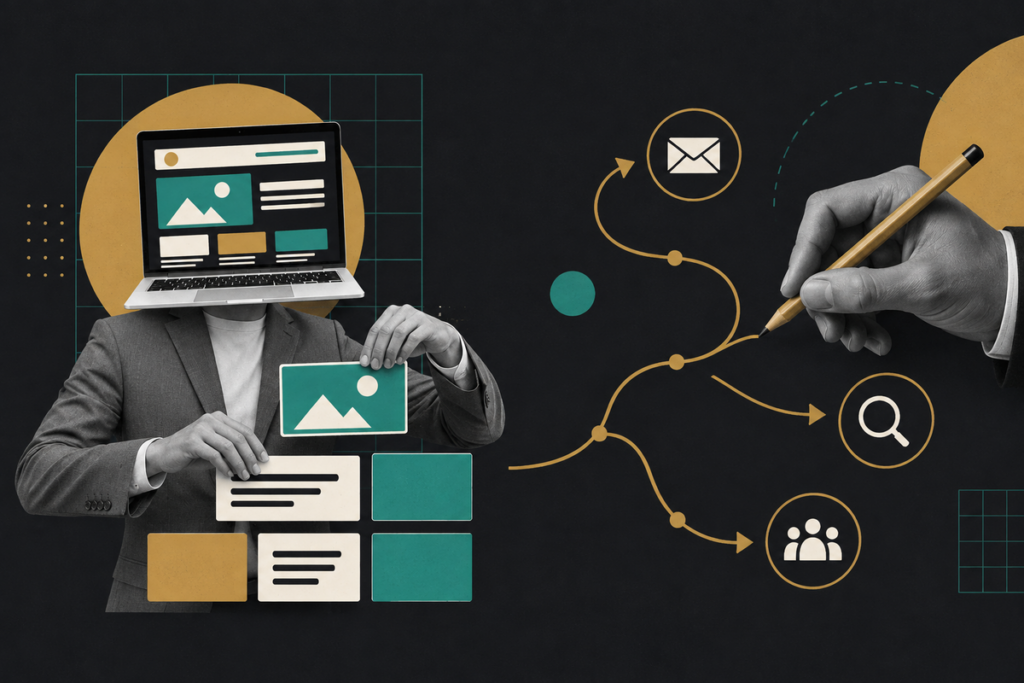
Imagine you’re a roofer. You ask an AI builder for a modern website offering roof repairs, flat roofing, pitched roofing and guttering. It can build those pages.
What it doesn’t automatically know is which work you actually want more of, which jobs are most profitable, how far you’re willing to travel, what customers worry about before calling you or why somebody should choose your company instead of another roofer three miles away.
Those decisions matter much more when the website is expected to generate business rather than simply exist.
If you’re testing an idea, running a side project or just need a simple online presence, AI could be an entirely sensible option.
But if your website needs to generate enquiries, support advertising, compete in search, sell products or explain a more complicated service, professional input becomes easier to justify.
Not because humans possess some secret ability to put text and pictures on a webpage.
AI has made that part dramatically easier.
What you’re increasingly paying for is the thinking around it: what to build, what not to build, what customers need to see, where traffic will come from and how you’ll know whether the site is working.
Additionally, you’re probably not immediately thinking about the growth you will hopefully have and how that will impact your business’s website. The AI will try and pigeon-hole you into a particular direction it decides is what you want – if your business suddenly adds on additional services or evolves to incorporate something – e.g. a donut shop developing into a fully fledged cafe – it will probably resist that new direction for a while.
And when it does change, it will likely drop the focus on the original products/services you offer, which isn’t what you wanted. This then becomes a bigger problem as some developers will either not want to work on an AI site on principle, and others will charge you big bucks to either adapt to the AI’s coding style or potentially redesign the site from scratch.
So the question probably isn’t:
Can AI build me a website?
It can.
The better question is:
Do I just need a website, or do I need my website to accomplish something for the business?
If that’s all you needed to know, you can stop here.
The long of it
AI websites have become genuinely capable
Dismissing AI website builders as glorified templates is becoming increasingly difficult.
Tools from companies including Wix, Webflow and Hostinger can now generate multi-page websites, written content and design systems from relatively simple prompts. Some can also add ecommerce, bookings and other business functionality.
AI adoption more broadly is growing quickly too. The Office for National Statistics reported that self-reported AI use among UK businesses with 10 or more employees rose from around 12% in late 2023 to around 35% by June 2026.
This isn’t experimental technology sitting somewhere on the horizon. Businesses are already using it.
Sometimes, AI probably is the right choice
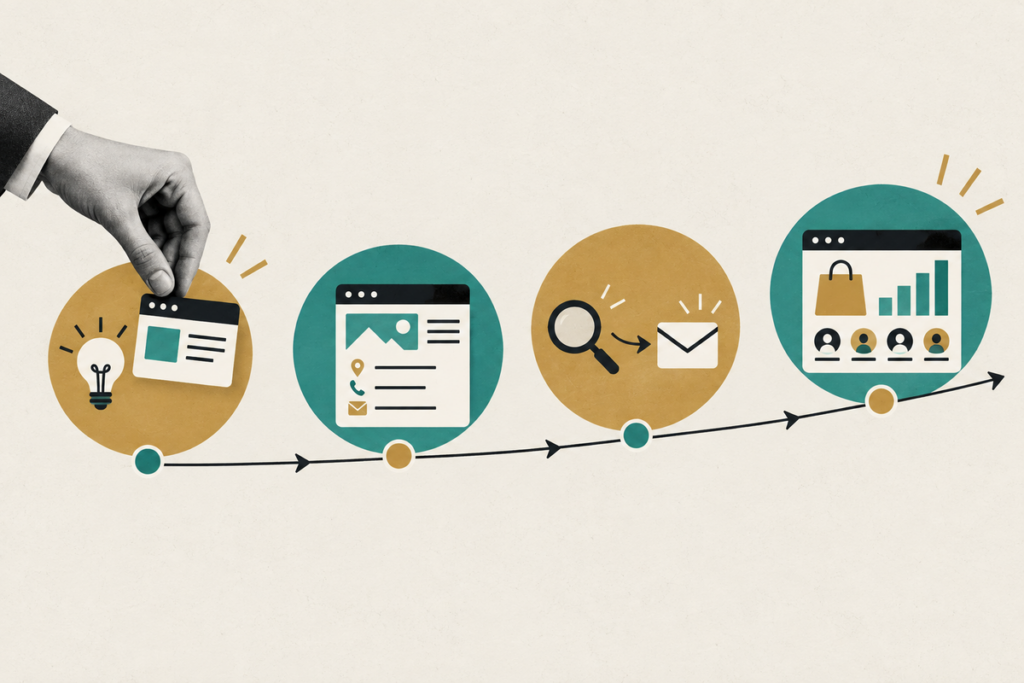
Suppose you’re testing an idea that may not exist six months from now.
Spending £2,000 or £3,000 building a website before you’ve established whether anyone actually wants the product could be unnecessary.
The same applies to somebody who gets almost all their work through referrals and only needs a basic website so prospective customers can confirm they’re legitimate.
A temporary project, portfolio or very small business with little available budget may also be perfectly well served by an AI-built site.
There’s no prize for spending more money than the problem requires. And paying a professional doesn’t automatically guarantee a better website either.
Where does professional input become valuable?
The calculation changes when the website starts carrying more commercial responsibility. Go back to our roofer:
Perhaps roof repairs generate plenty of enquiries but full reroofing projects are much more valuable.
Perhaps most profitable work comes from a 20-mile radius rather than everywhere across West Sussex.
Perhaps customers repeatedly ask about guarantees, insurance or how quickly emergency repairs can be completed.
Those things should influence the website. An AI builder can help you turn those decisions into pages. But somebody still needs to make the decisions. That’s increasingly what a good web professional should be paid for – not moving boxes around a screen.
Understanding the business before deciding which boxes need to exist.
AI doesn’t automatically mean bad SEO either
Another argument worth avoiding is that AI-built websites somehow cannot rank in Google.
That isn’t true. Google’s position is that content isn’t automatically penalised because AI helped create it. What matters is whether the result is useful and valuable to the person searching.
An AI builder can create headings, metadata and service pages. What it doesn’t automatically know is which searches are commercially useful to your business, which pages genuinely deserve to exist or what experience you can contribute that isn’t already being repeated across hundreds of similar websites.
That’s the difference between having SEO tools and having an SEO strategy. Humans can produce bad SEO too. AI has simply made producing lots of generic content much faster.
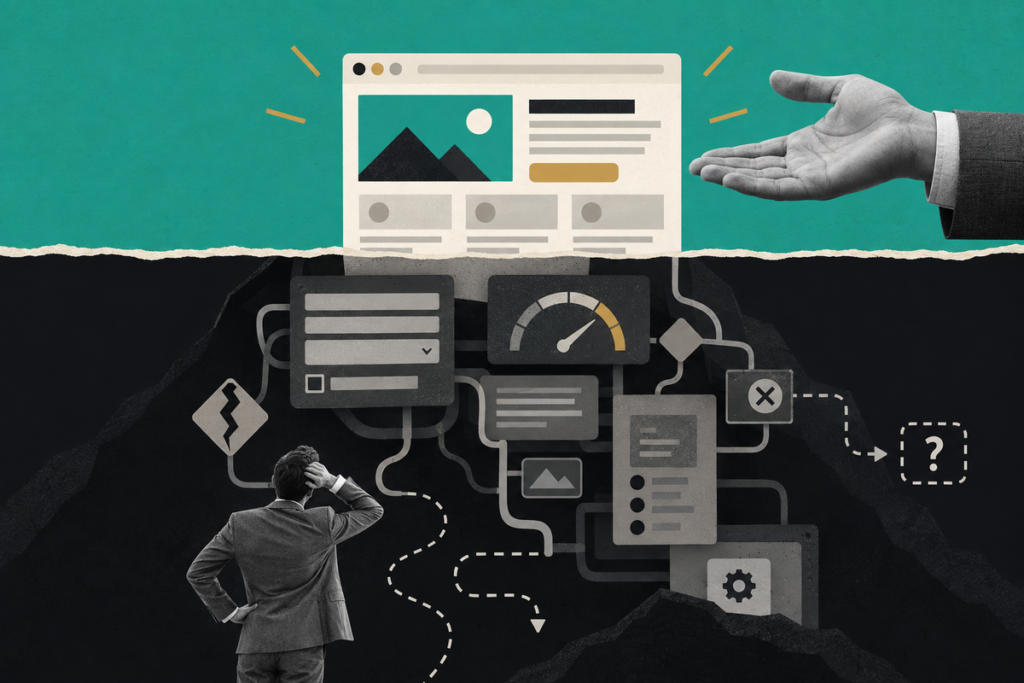
Looking finished doesn’t mean the job is finished
Modern AI builders can create something polished remarkably quickly. That’s useful, but appearances only tell you so much.
A website might look excellent while burying its most important service, asking too much on its contact form or failing to explain why somebody should choose the business.
Technical decisions can affect commercial results too. In one controlled test published through Google’s web.dev, Vodafone improved a key page-loading measure by 31%. The faster version was associated with an 8% increase in sales.
That doesn’t mean every faster website produces 8% more revenue. It does show that apparently small website decisions can affect what customers actually do. And that’s ultimately where the professional argument becomes strongest.
And what about growth?
AI site builders are great for simple websites, microsites or campaign landing pages. What they aren’t great at, in my experience, is scaling. Your business will, hopefully, grow and encompass more services or products over time. You’ll employ more people and require more customers to support that.
AI isn’t great at interpreting the organic nature of that growth. It will try to neatly pigeon-hole you into fitting to one thing and focus all of the written content around the core theme it thinks you want, and then be pretty hard to persuade to change its focus… and if it can be, it will often lose that focus on the original offering you provided.
So, you build it with AI, it’s fine and dandy. 6 months down the road you’re ready to grow and start hitting walls with your AI developer and realise it will be easier to hand the project over to a human developer. Problem is, rather than working off the site they designed, they are now railroaded into following the AI’s design and coding, or redesigning from scratch. I know some developers won’t touch that with a barge pole, and others will – for a wince inducing price.

So, should you pay someone?
Not always.
If you only need a straightforward online presence and know what it needs to say, an AI website builder may be completely adequate.
But if the website is expected to generate leads, support advertising, compete for valuable searches or influence purchasing decisions worth thousands of pounds, the cost of making the wrong decisions starts to increase.
That’s where professional input becomes easier to justify.
Not because AI websites are inherently bad. Not because Google dislikes them. And not because professionals should ignore the technology.
In reality, plenty of web professionals are already using AI themselves. The important distinction isn’t really robot versus human. It’s whether someone has understood the business problem before building the solution.
There is admittedly more to this than we can sensibly cram into a light read at 4pm on a Friday. SEO, analytics, accessibility, ownership and what happens after launch all complicate the picture further.
I’ll tackle those separately next week.