The short of it
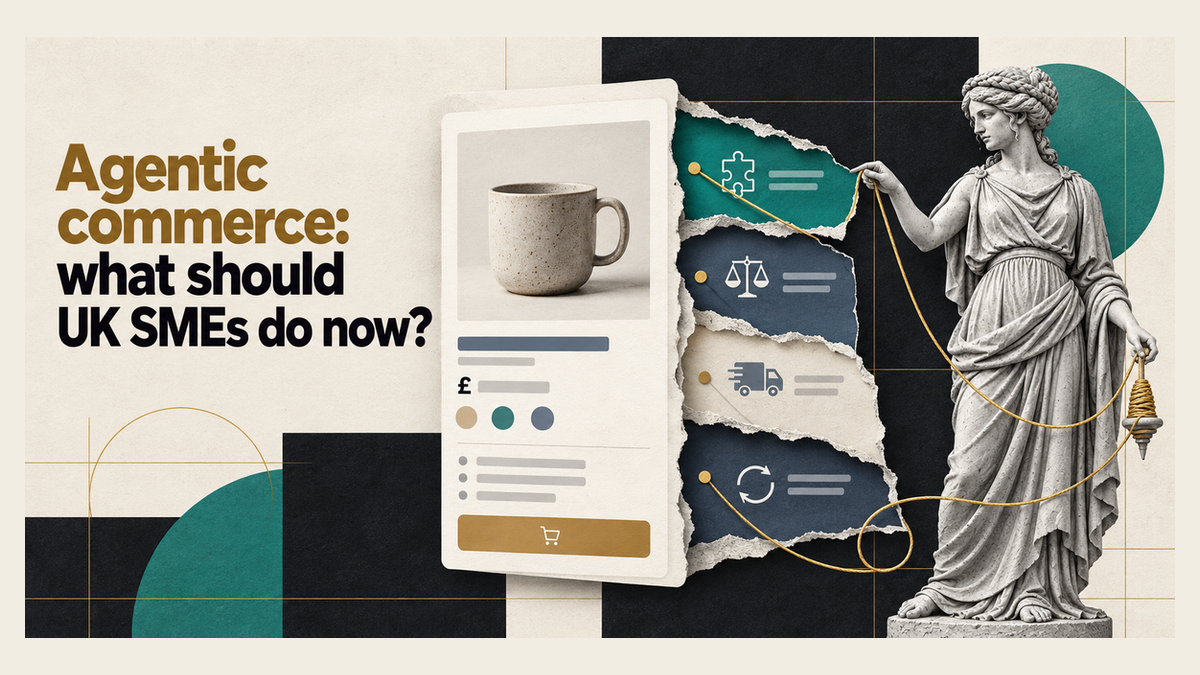
Agentic commerce is beginning to change how customers discover and compare products online. While it’s still developing, it’s something UK businesses should be paying attention to, particularly those with established ecommerce operations.
The concept is relatively straightforward. Rather than visiting multiple websites to research a purchase, customers can ask an AI assistant to find products that meet their requirements, compare the options and, in some supported circumstances, help complete a transaction.
Shopify, Google and OpenAI are already developing these capabilities, although availability varies depending on the platform, the customer’s location and where the merchant operates.
For most UK SMEs, this doesn’t mean immediately investing in new software or commissioning an expensive development project. Shopify already makes eligible products available to supported AI shopping channels automatically, subject to the relevant requirements.
However, there is a useful marketing question here: does your website give customers enough information to understand what you sell, who it suits and why they should choose it?
A product listing might include a price, photograph and basic specifications while leaving important questions unanswered. Is it compatible with something the customer already owns? How does it compare with a similar product? What makes it suitable for a particular application? What happens if it isn’t right?
Those questions matter whether someone is browsing your website directly or using an AI assistant to narrow down their options.
For an established retailer, the most sensible starting point is to review commercially important product pages, identify gaps in the information provided and consider whether those gaps are making purchasing decisions unnecessarily difficult.
This isn’t work that only becomes valuable when agentic commerce becomes more widely available. Better product communication can support existing SEO, advertising, email marketing and conversion performance today.
The opportunity isn’t necessarily about adopting another platform. It’s about making your existing website and marketing activity work harder as customer buying behaviour changes.
We’ve put together a practical guide to help UK businesses review their product information and decide which improvements deserve attention. If you’d like to work through that assessment, you can use it alongside the considerations below.
The long of it
What’s changing, and what actually applies to UK businesses?

The biggest development is that AI assistants are becoming another way for people to research purchases. Instead of manually comparing products across several websites, customers can describe their requirements and receive suggestions based on available product information.
Product discovery and completing a purchase are different capabilities, however, and they shouldn’t be confused.
Shopify’s agentic storefronts are enabled by default for eligible stores, allowing products to be discovered through supported AI channels without requiring merchants to purchase additional apps or commission bespoke development.
There are geographical restrictions. Shopify’s ChatGPT channel currently requires merchants to sell to US customers, although the business itself can be based elsewhere. Customers complete purchases through the retailer’s existing checkout.
Shopify-powered direct checkout through Google AI Mode and Gemini currently requires both a US-based store and US customers. Google announced plans to expand its wider commerce capabilities internationally, including to the UK, but that shouldn’t be treated as confirmation that every feature is available here.
For UK businesses, reviewing existing product information and sales performance is therefore a more useful starting point than making assumptions about future availability.
Could your product pages answer more customer questions?
Product descriptions have always influenced buying decisions, but AI-assisted comparison makes the quality of this information particularly relevant.
Imagine a specialist supplier selling replacement water-filtration cartridges. Its listing contains the manufacturer, model number, dimensions and price, which may be sufficient for someone ordering an exact replacement.
Another customer might need to know which systems the cartridge fits, whether it’s suitable for their application and how it compares with another model.
Adding verified compatibility details, useful comparisons and concise FAQs could make the product easier to evaluate. Clear delivery and returns information, alongside credible evidence supporting product claims, can provide additional reassurance.

None of this guarantees an AI recommendation. It does, however, help customers make better-informed decisions while providing clearer information for systems interpreting the product.
Which improvements are worth prioritising?
I’d start by reviewing three commercially important products rather than immediately auditing an entire catalogue.
Look at your strongest sellers, profitable ranges or specialist products that regularly generate customer questions. Consider what a first-time buyer would need to understand, whether the existing information answers those questions and where additional clarification could improve confidence.
The findings might point towards better product descriptions, stronger category pages, useful comparison content or improvements to the purchasing journey.
They might also reveal opportunities to improve how your SEO, paid advertising and email campaigns communicate product benefits, rather than treating every channel independently.

If your store already provides comprehensive information and converts visitors effectively, the review may reveal relatively little additional work. That’s a useful result too.
How do you measure whether it’s worthwhile?
Shopify provides sales and referral reporting for eligible agentic storefronts, while other analytics platforms may identify visitors arriving from AI services.
However, attribution remains imperfect. An AI recommendation might influence a customer who later returns through Google or visits the website directly, making its exact contribution difficult to establish.
Rather than concentrating entirely on whether products appear in AI-generated responses, I’d also look at product-page engagement, qualified enquiries where relevant, conversion rates, orders and revenue.
The objective is not simply more visibility. It’s understanding whether your marketing activity helps generate commercially valuable outcomes.

Where should your business go from here?
Agentic commerce deserves consideration, but it shouldn’t automatically take priority over existing website or marketing problems.
If customers already struggle to find the right products, descriptions leave important questions unanswered or your reporting doesn’t clearly show which activity generates sales, those are sensible places to invest attention now.
Our Preparing for AI shopping: a practical guide for UK SMEs provides a structured way to review important products, identify information gaps and prioritise improvements without committing to an unnecessary technical project.
Download the guideIf you’d prefer support putting those findings into practice, Clotho Digital can help you review product content, improve website journeys and connect those changes to your wider SEO, advertising and marketing activity.
Whether the next step is a relatively small content improvement or a broader review of your website’s commercial performance, the aim should be the same: making it easier for the right customers to understand what you offer and confidently choose your business.